
Soft Hockey
Soft Hockey is a team sport introduced from the United States in 2009, which originated from the ancient ice hockey and green field field hockey, and is a competitive team sport in which the ball is hit into the opposing team's goal with a foam-covered straight stick in a prescribed field, and the winner is determined by the number of points scored in a prescribed period of time.
According to the physical and mental characteristics of young children and the actual situation of kindergartens in China, Dadi has made brand-new improvements to the rules and regulations, equipment and teaching research and development, which can enable children to develop various abilities and take care of their young minds and bodies. It is the most suitable team sports for young children in China, and also the most suitable team education program for kindergartens
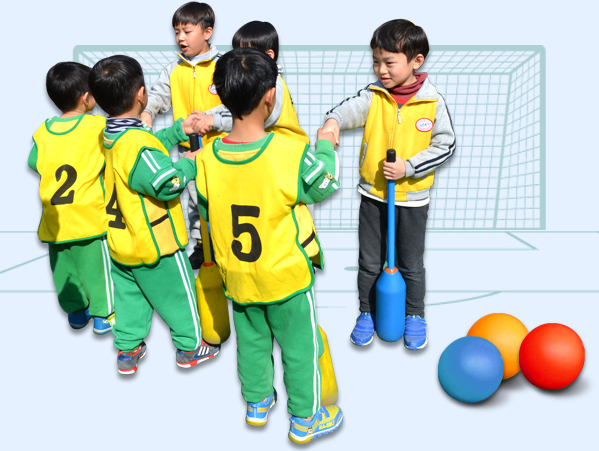
All the equipments are processed with safety design and passed the environmental protection and safety test: sponge bat, non-slip handle, no puncture, no pain in hitting, self-inflating crocodile soft leather ball, ABS round corner fence, operating for three years without a single safety accident.
The setting of the venue partition in the primary competition avoids collective collision, improves the safety coefficient, promotes each other's teamwork and the awareness of rules at the same time, there is also a more important point is that it gives the children a relatively independent space, gives them the responsibility and role of the position, " he is in charge of his territory", which can help to enhance the sense of responsibility, even if it is introverted and sensitive, and the outside world of the children with a high level of vigilance are also able to cooperate with others, participate in it, and continue to improve.
After a child has built a good foundation of teamwork, rule awareness, and tactical skills through the beginner level (3-player, framed), he or she can move on to a higher level of play. 4-player or 5-player games have a larger field and break down the limitations of the framed area in a 3v3, which makes them more confrontational, more athletic, more intense, and more stimulating!
1. This is a whole-body sport, which makes up for the lack of exercise for the upper limbs of children in China, and puts forward higher requirements and honing opportunities for the sense of balance and coordination of the limbs.
2. All-round safety considerations, so that teachers are freed from the anxiety and control behavior of children's safety, so that they can devote more time to observe and guide children's activities.
3. Focusing on the educational value of the environment, mobilizing children's physical and mental abilities to comprehensively apply to the competition activities, and promoting the play and internalization of children's multiple abilities.
4. Simple and easy to implement low threshold, simple rules, covers an area of only 24 square meters, low participation threshold, so that the internal teaching is easy to implement, external parent-child activities with high participation, twice the result with half the effort.
1. Physical side:
(1) Make up for the lack of upper limb exercise that is common among young children in China;
(2) It helps to cultivate good exercise habits and abilities of young children;
(3) Left and right hand-held poles promote the development of the whole brain and provide good brain physiology for intelligent activities;
(4) The equipment and rules are as safe and reliable as possible (equipment, rules, not a single injury accident in three years)
2. Psychological and social aspects:
(1) Children develop a sense of cooperation by collaborating to accomplish common task goals
(2) Establishing a sense of belonging through community activities and exchanges.
(3) Competitive activities cultivate children's sense of competition and their ability to reasonably face the frustration caused by success or failure.
(4) Enhance children's ability to cope and solve problems on their own through the environment created by competitions.
(5) Developing a sense of rules and habits
(二) To the kindergartens
1. Combining outdoor physical fitness and team education, expanding intellectual education to the field of team education, and enhancing the brand's gold content with internationalized height and vision.
2. Comprehensively improve the physical fitness of children in the kindergartens. Professional equipments and systematic activities meet the requirements of "innovative sports, forming the culture and sports characteristics of the school", which is helpful for kindergartens evaluation.
3. Soft Hockey games are easy to operate, low threshold, high participation of parents, especially male parents, and never get tired of it, which is the most cost-effective and worry-free enrollment and parent-child activities.
4. As a team sport, it is safer than soccer and basketball, and the growth environment of team games is more permeable.
5. Focus on the development of long-term interests of the campus, made into a long and stable teaching characteristics. Increase the participation of young students and parents, thus promoting the whole kindergartens to raise fees and increase the number of students.
(一) Regular activities in the kindergarten
1. Weekly regular Soft Hockey activities (1~2 activities per week, 40~50 minutes each time)
Junior class - design games around soft hockey play equipment and add them to the physical fitness program.
Middle class - Soft Hockey games + semester-long weekly practice sessions
Senior class - semester league games + inter-garden tournaments.
Attention:
-Establish the roles of striker, defender, coach, referee, little teacher, cheerleader, logistics chief, etc. in daily activities, and the children will develop their team coordination, organization and leadership skills by taking different roles.
-Through the combination of art and craft, music and dance, diversify the cultural life of the community such as I draw my team, make or draw their own team logo, name their team, cheerleading dance, cheerleading drill, and the creation of team slogans.
2. Soft Hockey Parent-Child League (once a semester, for the whole school, parents participate in the game and children do not participate in the game for small classes; parents and children participate in middle and large classes)
(二) Choose to conduct
1、Soft Hockey Interest Classes/Specialty Classes/Clubs (16 hours per semester, 40~50 minutes per session)
2. Inter-city league between large and medium-sized gardens (more than 2 schools in the same city can be organized)
3、Soft Hockey Regional Independent Activities
1.Add a soft hockey competition experience session in parent-child sports games and gardening activities to strengthen the promotion to parents
2. Dadi provide coordinated design and production support for publicity materials.
3. Provide soft hockey referee training for class teachers leaving the park.
4. For the organization and planning of kindergarten activities, dadi provides project information and one-on-one training support.